
Firm Price in 24 Hours: Quote vs Estimate for Builders

A quote is a fixed price for defined work; an estimate is a non-binding approximation based on the information available at the time. If a builder or tradesperson hands you either document, ask for it in writing and check it’s actually labelled “quote” or “estimate” rather than left vague. Everything below explains why that label matters and what each document should contain before you sign anything.
TL;DR:
A quote offers a fixed, detailed price after a full assessment and is legally binding once accepted, with clear itemization, exclusions, and a validity period.
An estimate provides a non-binding range based on early-stage information, including assumptions and a cost bracket, suitable for ambiguous or preliminary projects.
Use estimates for small repairs or early planning, and insist on a quote for structural work, large projects, or when certainty and binding prices are essential.
Proper quotes and estimates must include a date, clear label, scope, exclusions, assumptions, validity, and payment terms, with quotes requiring more detailed breakdowns.
Mislabelling documents as quotes or estimates can cause disputes; always verify the actual content and request a signed quote before making payment.
Table of Contents
What is a quote?
A quote is an offer of a fixed price, arrived at only after a proper assessment of the job. That usually means a site visit, measurements, and a full specification of materials and labour. Once you accept it, a quote commonly forms the basis of a binding agreement, and the price stated is the price you pay for that agreed scope, unless both parties sign off on a change.
Because a quote follows detailed assessment, it can afford to be precise. That precision is exactly what makes it suitable as the foundation for a contract and a payment schedule. A proper quote should include:
An itemised breakdown of labour, materials, and any subcontracted work
Clear exclusions (what’s not covered, such as skip hire or asbestos removal)
Payment terms and a schedule tied to project milestones
A validity period, typically 30 to 90 days, protecting both sides against rising material costs
That validity period matters more than most homeowners realise. Timber, insulation, and steel prices can shift within weeks, and a quote without an expiry date leaves a builder exposed to honouring an old price on new material costs, which is exactly the kind of thing that leads to awkward renegotiation mid-project.
What is an estimate?
An estimate is an educated, non-binding approximation of costs, built on whatever information is available at that early stage. It’s not a guess pulled from thin air. It’s a professional judgement, but one that’s likely to move once the full scope becomes clear.
Good estimating practice means giving a range rather than a single number, and recording the assumptions behind it. Stating a best-case and worst-case figure prevents the shock of a final invoice that looks nothing like the number you were first given. A well-written estimate should include:
A price range rather than one fixed figure
The assumptions it’s based on (for example, “assumes no structural issues found on opening up the wall”)
A note that the figure is non-binding and subject to change
An indication of when a firmer number will follow, and what triggers it
You should expect an estimate early in a project, when details are still being defined or the work itself is inherently variable, such as repairs where the extent of damage isn’t visible until work starts. As a rough guide, an estimate landing within around 20% of the final price is often considered reasonable. Anything wildly outside that range suggests either poor initial assessment or scope creep nobody flagged early enough.
Quote vs estimate: what actually separates them?
The two documents differ on four practical points: how binding they are, how much detail they contain, when in the project they appear, and how changes get handled afterwards.
Factor | Quote | Estimate |
Binding status | Fixed and binding once accepted | Non-binding, subject to change |
Detail level | Itemised costs, exclusions, terms | Approximate range, key assumptions |
Timing | After survey or full specification | Early discussion, before full scope known |
Handling changes | Requires a signed change order | Naturally expected to shift |
Two simple decision rules cut through most of the confusion:
Ask for an estimate when real uncertainty exists, such as unknown conditions behind a wall or a job that could go several different ways depending on what’s found.
Insist on a quote before committing money to a firm budget, particularly for anything involving structural work, planning permission, or a fixed completion date.
Mislabelling is where most disputes start. A document titled “estimate” that reads like a fixed contract, or a “quote” full of vague caveats and no itemisation, confuses everyone involved. Courts and adjudicators generally look past the title and examine the document’s actual wording and the parties’ behaviour. Calling something a quote doesn’t make it one if it reads like a rough guess, and calling something an estimate doesn’t protect a contractor who treated it as final.
When should you ask for an estimate, and when should you demand a quote?
Match the document to the size and certainty of the job, not habit.
Small, well-understood repairs (a leaking tap, a broken fence panel, a single-room repaint) rarely need more than an estimate. The scope is obvious and the variance is small.
Anything involving hidden conditions (rewiring an old property, replacing a roof where the state of the joists is unknown) should start as an estimate, then convert to a quote once the tradesperson has opened things up and confirmed what’s actually there.
Large structural projects such as extensions, loft conversions, or major refurbishments need a full quote before work begins, built on a proper survey and specification, not a phone conversation.
When asking a tradesperson directly, be specific: “Can you give me a written quote with an itemised breakdown and a validity period?” or “At this stage, I’d like an estimate with your best and worst-case figures and the assumptions behind them.” Naming the document you want, in writing, avoids the whole mislabelling problem before it starts.
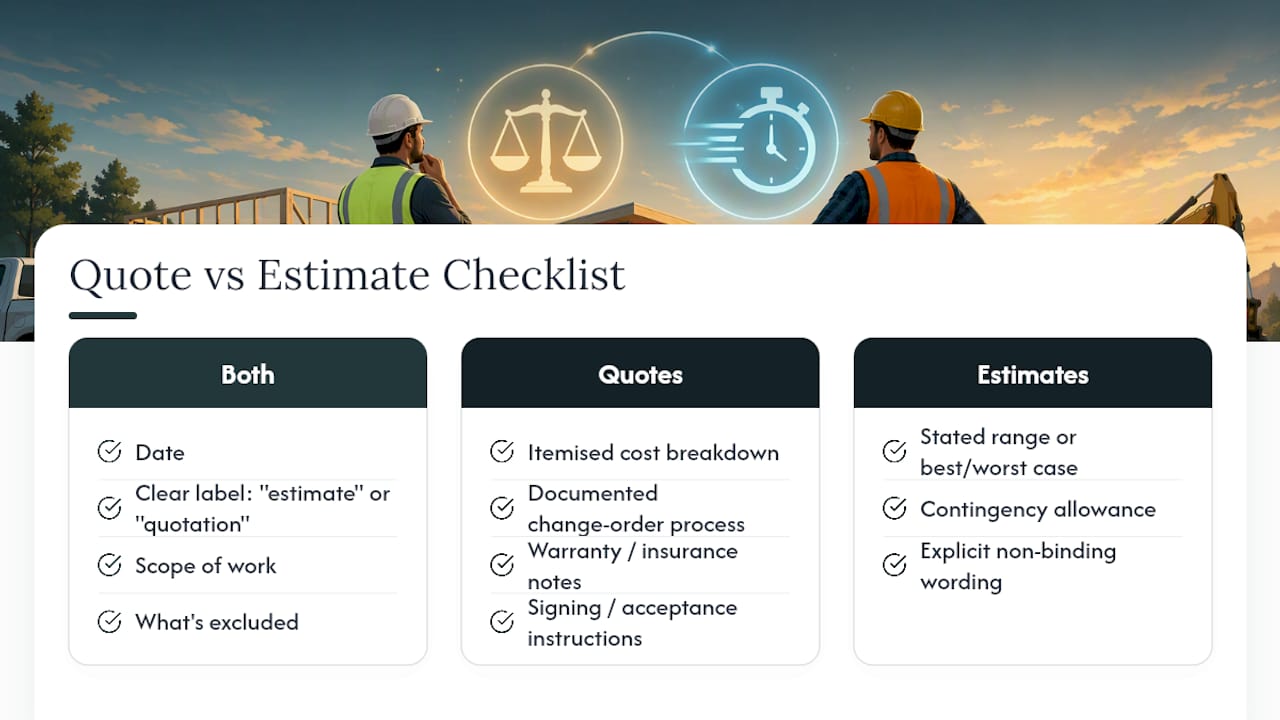
Checklist: what a proper quote or estimate should include
Both documents need a date, a clear label (“estimate” or “quotation”, not something ambiguous like “pricing outline”), the scope of work, what’s excluded, the assumptions behind the figures, a validity period, and stated payment terms.
Quotes need to go further. Look for an itemised cost breakdown, a documented process for handling change orders, any notes on warranty or insurance cover, and clear instructions for signing or accepting the offer.
Estimates need their own extra layer: a stated range or best/worst-case figure, a contingency allowance for the unexpected, and explicit wording that says the number is non-binding.
Pro Tip: If a document doesn’t say anywhere on it whether it’s an estimate or a quote, treat that as a red flag rather than a technicality. Ask the provider to reissue it with the correct label before you agree to anything.
Turning an estimate into a firm quote (and handling changes along the way)
The sequence that avoids most disputes runs: initial estimate, then a site survey or full specification, then a formal quote, then your acceptance, then signed change orders for anything that shifts afterwards.
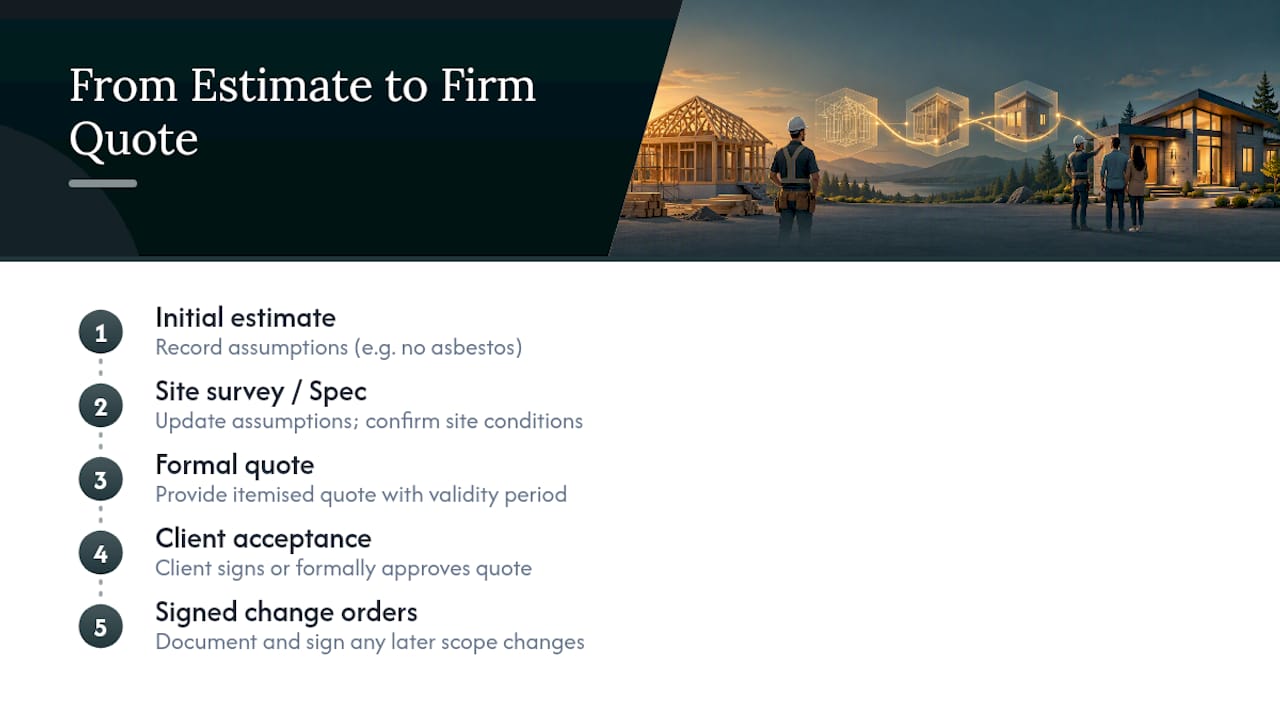
Record assumptions at every stage. If an estimate assumed no asbestos and the survey finds some, that assumption needs writing down and updating, not quietly dropped. Watch for warning signs at any point in this chain: scope described in vague terms, a large deposit requested before you’ve seen an itemised quote, or a quote with no validity period at all. A documented change-order process keeps both sides protected once work is under way and something inevitably needs adjusting.
How a builder should handle quotes and estimates in practice
Evostruct’s approach reflects the sequence above: detailed quotes delivered within 24 hours of assessment, backed by live virtual tours so clients can see real project workmanship before committing. That speed and visibility cut the waiting-and-wondering that usually breeds disputes. When you’re talking to any builder, borrow the phrasing: “Can I get a written quote with a validity period?” or “Can I see examples of your current work before I decide?”
A quick checklist before you commit any money
Compare documents side by side for clarity, itemisation, and stated assumptions. Check proof points like insurance and references, then ask for a start date and payment schedule. If anything still feels loose, ask for the estimate to be converted into a signed quote before a penny changes hands.
— Florin
Get a fast, transparent quote for your next project
Evostruct is the alternative to the slow, back-and-forth quoting process most builders put you through. Rather than waiting weeks for a written price, Evostruct promises a detailed quote within 24 hours of assessment, and lets you view live construction projects through virtual tours before you commit, so you can judge workmanship and project management for yourself rather than taking anyone’s word for it.

Whether you’re planning a loft conversion, a single or double storey extension, a garden room, or a garage conversion, that same speed and visibility applies. If your project involves structural changes or a fixed budget, you need a proper quote, not a rough guess, and that’s exactly what Evostruct is built to deliver quickly. Browse the residential building services on offer, or head straight to the instant quote page to start the process and see how fast a properly itemised quote can actually arrive.
Sources
FAQ
What is the difference between an estimate and a quote?
An estimate is a non-binding, approximate figure based on limited information, while a quote is a fixed price offered after a full assessment of the job. Once you accept a quote, it typically becomes the basis of a binding agreement for that scope of work.
Is a quote a final price?
Yes, a quote is intended as the final price for the agreed scope, and it stays fixed unless both parties sign a change order for extra work or altered specifications. That’s why a proper quote should always state a validity period, since material and labour costs can shift after that window closes.
What is the difference between an estimate, a quote, and an invoice?
An estimate is a rough approximation, a quote is a fixed offer for defined work, and an invoice is the actual bill issued once work is complete or at agreed payment stages. The invoice should match the accepted quote unless documented changes were made along the way.
Is a quote the same as a price?
A quote states a price, but it’s a price tied to a specific scope, exclusions, and a validity period, not just a number on its own. If the scope changes after you accept, the original quoted price no longer applies until a new figure is agreed in writing.
How much does Evostruct charge for a loft conversion or extension?
Loft conversions with Evostruct start from £35,000, while single and double storey extensions typically range from £45,000 to £85,000 depending on scope. Exact pricing depends on your property and specification, which is why Evostruct provides a detailed written quote within 24 hours of assessment.
Recommended

Comments